

A missing sock, a chewed-up toy, half a corn cob from the trash. If your dog swallowed something it should not have, the next few hours matter more than most owners realize. Some objects pass on their own. Others lodge in the stomach or intestines and turn into a surgical problem fast. As a locally owned animal hospital near me option in Tracy, we see these cases often, and the dogs who do best are the ones whose owners reached out for emergency vet services early. This guide covers the warning signs, how vets confirm a blockage with imaging, and what treatment actually looks like.
Why Dogs Swallow Things They Shouldn’t
Dogs explore with their mouths. Puppies teethe, bored adults chew, and food-motivated breeds swallow first and think later. The American College of Veterinary Surgeons explains that gastrointestinal foreign bodies occur when pets eat non-digestible items that will not readily pass through the stomach or intestines.
The Usual Suspects
- Socks, underwear, and dish towels
- Toy pieces, squeakers, and rope toy fibers
- Corn cobs and fruit pits
- Cooked bones and rawhide chunks
- Sticks, rocks, and acorns
- Hair ties, ribbon, and string
- Batteries, magnets, and coins
Dogs at Higher Risk
Young dogs top the list. Embrace Pet Insurance reported that 66 percent of its foreign body ingestion claims in Q3 2025 involved pets under two years old. Labradors, Golden Retrievers, and high-energy working breeds also show up often, especially when they are bored or left alone for long stretches.
Signs Your Dog Has a Foreign Body
Symptoms depend on what was swallowed, where it is stuck, and how long it has been there. Some dogs show signs within hours. Others seem fine for a day or two before getting sick.
Early Warning Signs
- Vomiting, especially after eating or drinking
- Loss of appetite or refusing favorite treats
- Lethargy or unusual quietness
- Drooling, gagging, or repeated swallowing
- Straining to pass stool, or small amounts of diarrhea
Signs That Need Emergency Vet Services Now
- Repeated vomiting where nothing stays down, including water
- A painful, tense, or bloated belly
- Hunching, a “prayer position,” or reluctance to lie down
- Pale gums, weakness, or collapse
- Retching that brings nothing up
- String or fabric visible from the mouth or rear
Partial vs. Complete Obstruction
According to the Merck Veterinary Manual on gastrointestinal obstruction, large round objects often cause complete blockages, while linear or small objects are more likely to cause partial ones. Partial blockages are tricky because a dog may still eat a little and pass some stool, which makes owners think things are improving. Without treatment, a blocked section of bowel can lose its blood supply, so any obstruction should be treated as urgent.
What to Do in the First Hour
Your first move is a phone call, not a home remedy. Fast access to emergency vet services is what keeps a simple retrieval from becoming abdominal surgery. Reach out to an urgent care animal hospital or your regular vet and describe exactly what happened.
- Do not induce vomiting at home unless a veterinarian tells you to. Sharp items, batteries, and caustic materials can do more damage coming back up.
- Never pull a string hanging from your dog’s mouth or rear. It may be anchored inside and can cut the intestines.
- Note the time your dog ate the object, or your best guess.
- Bring evidence: the remaining toy, the packaging, or a matching item so the vet can judge size and material.
- Hold off on food and water until a vet advises you.
If your dog already shows the emergency signs above, skip the waiting and head in. Same-day dog urgent care is far easier on your pet than surgery for a blockage that has been building for days.
Which Swallowed Objects Are Most Dangerous?
| Object | Risk level | Why it matters |
|---|---|---|
| String, ribbon, rope fibers | Very high | Can bunch the intestines and saw through the wall |
| Button batteries | Very high | Can cause chemical burns within hours |
| Multiple magnets | Very high | Attract through intestinal walls and pinch tissue |
| Corn cobs | High | Rarely break down, common cause of small intestine blockage |
| Socks and fabric | High | Expand with fluid and lodge easily |
| Cooked bones | High | Splinter, lodge in the esophagus, or puncture the gut |
| Small smooth toys or coins | Moderate | Some pass, some lodge; imaging decides |
How Vets Diagnose a Foreign Body
History and Physical Exam
The doctor will ask what your dog ate, when, and what symptoms followed. Gently feeling the abdomen can reveal pain, gas, or sometimes the object itself. Bloodwork from our in-house lab shows dehydration and electrolyte changes caused by vomiting, which helps guide fluids and anesthesia planning.
X-Rays
Radiographs are usually the first imaging step. Metal, stone, and bone show up clearly. Fabric and plastic often do not, but the gas patterns around them can still point to a blockage. If you are searching for a pet x ray near me, our clinic offers multi-view radiographs and recheck films to track whether an object is moving.
Ultrasound
Ultrasound fills the gaps X-rays leave. It can show fabric, plastic, fluid buildup, and thickened or bunched intestine. A pet ultrasound near me visit is especially useful when X-rays are unclear but symptoms keep pointing toward an obstruction.
Imaging Compared
| Method | Best at finding | Limitations |
|---|---|---|
| X-ray | Metal, bone, stones, gas patterns | Misses many soft objects |
| Ultrasound | Fabric, plastic, fluid, intestinal changes | Gas can block the view |
| Contrast study | Slow movement or partial blockage | Takes hours of serial films |
| Endoscopy | Objects in the esophagus or stomach | Cannot reach most of the intestines |
Treatment Options
Monitored Passage
Small, smooth objects with no signs of blockage may be allowed to pass. Your vet may recommend repeat X-rays to confirm the object is moving and give clear instructions on what to watch for at home.
Induced Vomiting
If the object is soft, non-toxic, and was swallowed very recently, a veterinarian may give medication to bring it back up. This is never right for sharp items, batteries, or dogs that are already vomiting or lethargic.
Endoscopy
A flexible camera passed through the mouth can retrieve some items from the esophagus or stomach without an incision. The Merck Veterinary Manual notes that bones are the most common esophageal foreign body in dogs, and these should be removed right away. When endoscopy is the best route, we coordinate referral to a facility that offers it.
Surgery
When an object is stuck, sharp, or linear, surgery is usually the safest path and the core of most emergency vet services for foreign bodies. Our clinic performs exploratory surgery and foreign body removal as part of its veterinary surgery near me services. Common procedures include a gastrotomy (opening the stomach), an enterotomy (opening the intestine), and, if a section of bowel is damaged, a resection to remove it and rejoin healthy ends. Urgent surgery always starts with a phone call so the team can prepare.
Recovery After Foreign Body Surgery
- Expect a short hospital stay for fluids and pain control
- Keep a cone on to protect the incision
- Feed small, bland meals as directed
- Restrict running, jumping, and stairs for about two weeks
- Check the incision daily for swelling or discharge
- Call immediately if vomiting, belly pain, or lethargy returns in the first few days
What the Data Says
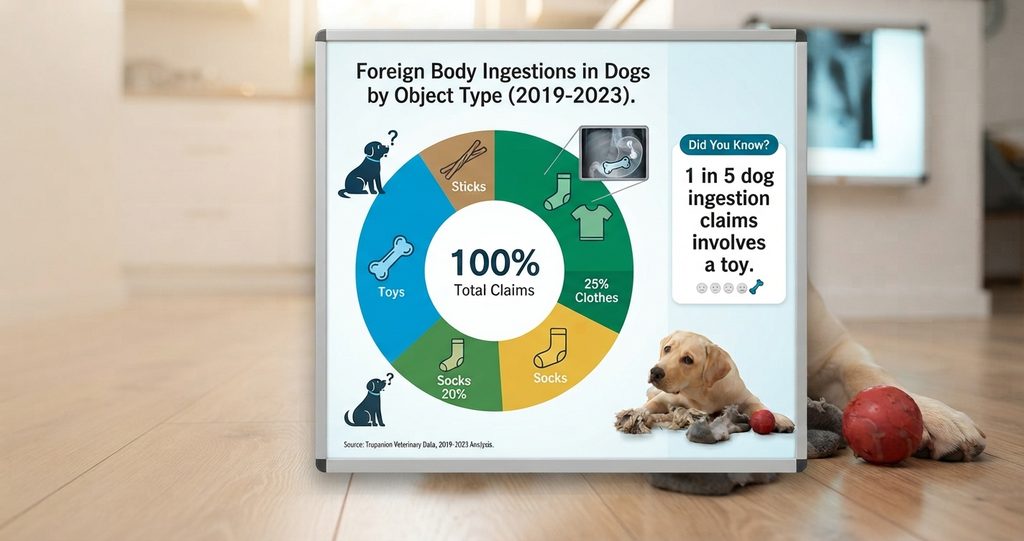
Pet insurer Pumpkin reviewed its dog ingestion claims from October 2020 to October 2025 in its foreign body and toxic ingestion report. Here is how the leading non-food items stacked up:
| Item swallowed | Share of dog ingestion claims |
|---|---|
| Toys | 20.4% |
| Clothes | 12% |
| Sticks | 9.1% |
| Socks alone | 8% |
Our own 2026 keyword research shows the same urgency from the search side. About 9,900 people a month search “emergency animal hospital,” and another 4,400 search “emergency vet services.” Very few search for prevention. Most owners start looking for help only after the object is already gone.
Illustrative Scenarios
These are example situations, not individual patient records.
The Puppy and the Squeaker
A six-month-old pulls the squeaker out of a plush toy and swallows it, then plays normally. Next step: call right away. Within the first couple of hours, a vet may safely induce vomiting. Waiting until the puppy starts vomiting usually means imaging and possibly surgery.
The Sock That Disappeared Yesterday
An adult Lab vomited three times overnight and refuses breakfast. Next step: same-day exam with X-rays and likely ultrasound. Fabric rarely shows on X-ray, so ultrasound often confirms the blockage.
The Rope Toy Strings
A terrier has been shredding a rope toy for days and now has a tight, painful belly. Next step: emergency vet services immediately. Linear material is among the most dangerous foreign bodies.
A Quick Word on Cats
Cats are less likely to eat socks but far more likely to swallow string, thread, or tinsel. Pumpkin’s data lists string as the top foreign body emergency in cats. If your cat is vomiting and you find a missing hair tie or thread, look into cat urgent care the same day, and never pull anything visible under the tongue.
Prevention Checklist
- Pick up socks, hair ties, and laundry
- Use a locking trash can, especially after barbecues
- Replace toys once they start to tear
- Choose chews sized larger than your dog’s mouth
- Supervise rope toys and remove loose fibers
- Give bored dogs puzzle feeders and daily exercise
When You Need an Emergency Animal Hospital Near Me
Tracy Veterinary Medical Center welcomes emergencies and walk-ins while we are open, but we are not a 24-hour facility. If your dog shows severe signs after we close, find an emergency animal hospital near me that is open overnight and go directly there. Do not use a website form and wait for a reply. Save that overnight number in your phone today, alongside ours: (209) 447-0395.
Why Tracy Pet Owners Trust Our Team
Tracy Veterinary Medical Center opened in 2023, founded by four people who live in this community. Our listed doctors bring more than 60 years of combined experience, and Dr. Erin Paster, a board-certified veterinary surgeon (DACVS), visits to support advanced soft tissue and orthopedic procedures. With radiographs, ultrasound, in-house lab work, surgery, and a pharmacy under one roof, our animal hospital urgent care visits move from diagnosis to treatment without unnecessary transfers.
Frequently Asked Questions
-
How long does it take for a dog to pass a foreign object?
Most food moves through a dog’s digestive tract within about one to two days, and small, smooth objects may follow a similar timeline. Larger, sharp, or fabric items often never pass on their own. Because there is no safe way to know at home, call your veterinarian as soon as you suspect your dog swallowed something. Imaging can show whether the object is moving or stuck, which decides whether watching at home is a reasonable option.
-
Can a dog still poop with a blockage?
Yes, and that confuses many owners. With a partial obstruction, some liquid stool or small amounts of feces can still get past the object. A dog may even eat a little. That does not mean the problem is resolving. Ongoing vomiting, reduced appetite, belly pain, or lethargy alongside normal-looking stool still warrant a veterinary exam and imaging to rule out a blockage before it becomes more serious.
-
Should I make my dog throw up after eating something?
Not without a veterinarian’s guidance. Inducing vomiting at home can be dangerous if the object is sharp, a battery, or a caustic chemical, and some home methods irritate the stomach badly. A vet will first decide whether vomiting is safe based on what was swallowed, how long ago, and your dog’s condition. If it is appropriate, the clinic uses medication that works more reliably and with fewer risks.
-
Will a foreign body always show up on an X-ray?
No. Metal, bone, and stone show clearly, but fabric, plastic, rubber, and many toys often do not. Vets look for indirect clues such as abnormal gas patterns and dilated intestinal loops. When X-rays are unclear, ultrasound or a contrast study can provide answers. That is why a dog with persistent symptoms may need more than one type of imaging before the team can confirm or rule out an obstruction.
-
When do I need emergency vet services instead of waiting?
Go in right away if your dog is vomiting repeatedly, cannot keep water down, has a painful or swollen belly, seems weak, or has string visible from the mouth or rear. Known ingestion of batteries, magnets, corn cobs, or bones also justifies an immediate visit even without symptoms. During our open hours, call ahead so the team can prepare. After hours, go to the nearest overnight emergency animal hospital without delay.
Most foreign body cases end well when owners act early, so if something went missing and your dog looks guilty, make the call today.